The straight line runs out
When you start lifting, almost any sensible program works. Your body is answering a demand it hasn’t met before, and it answers quickly, so a small jump every week is something you can absorb. That’s why linear progression is the classic way to start: the same sets and reps, a little more weight each time.
The catch is that the jump stays the same size while the room for it shrinks. The closer you get to what you can lift today, the less each week has to give. And on the lighter lifts the jump is bigger than it looks. 2.5 kg is about 4% of a 60 kg bench. On a 180 kg deadlift it’s under 1.5%. That’s why bench and overhead press tend to stall before squat and deadlift do.
None of this means you did something wrong. The plan that got you here has done its job.
A bad day and a stall look the same for one session
One flat session tells you very little. A short night, a long day at work, a busy gym or a different time of day all show up on the bar.
A stall is the same work, at the same effort, going nowhere for a few weeks running. Telling the two apart matters, because they need opposite answers. A bad day needs nothing changed. A stall needs the plan to change.
What actually helps
None of these are secrets. Good coaches have used them for a long time.
- 01
Climb the reps before the weight
Pick a range, say 6 to 8 or 8 to 12. Stay at a weight until every set reaches the top, then add the smallest step you can and go back to the bottom. You keep making progress you can see, in pieces smaller than a plate. It’s called double progression.
- 02
Change the work in blocks
A few weeks of more sets at moderate weights, then a few weeks of heavier, lower-rep work, gives your body a new demand to answer. The same sets and reps, repeated for ever, stop asking anything new.
- 03
Set today’s weight by effort
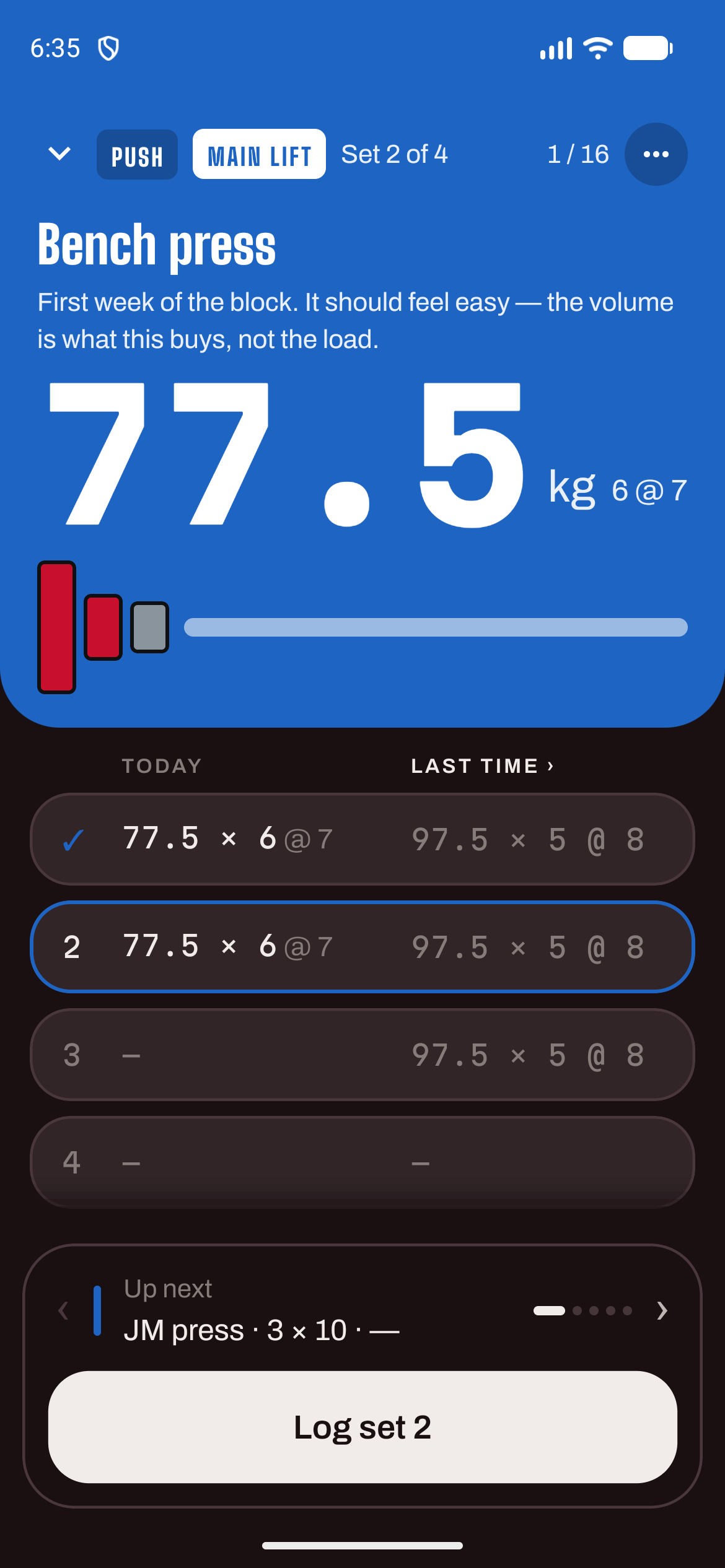
RPE rates a set by the reps you had left: RPE 8 means about two more. If the target was 8 and the set felt like a 7, the next one can go up. If it felt like a 9, it can come down for today. One session shouldn’t move the max the rest of your program is built on.
- 04
Plan the deload week
A deload week, written into the block, lets the fatigue of the hard weeks settle so the next block starts fresh. It’s part of the program, there on purpose.
- 05
Keep turning up
Months of ordinary sessions do more than any single heroic one. Outside the gym, sleep and eating enough count for more than any detail on this page.